
Mental Resilience

When you care for everyone else, it is easy to lose yourself.
If you've been raising a neurodivergent child for any length of time, you've probably become an expert at holding everything together. You remember the appointments, advocate at school, anticipate meltdowns, manage family life, and keep moving even when your own energy has long since run out.
People often tell parents to "stay calm" or "look after yourself," as though resilience were simply a matter of trying harder. But when your nervous system has been living in a state of constant alert, calm isn't something you can force. It is something you learn to rebuild.
The truth is that you cannot consistently lead from a place of depletion. When your body is overwhelmed, your mind becomes reactive. Decisions become harder, patience becomes shorter, and even small challenges can feel impossible. This isn't because you are failing. It is because your nervous system is doing exactly what it was designed to do: protect you.
Your child does not need a perfect parent. They need a parent who knows how to return to calm after stress, who can pause before reacting, and who can model emotional steadiness even when life feels uncertain.
That is what mental resilience is.
It is not about ignoring difficult emotions or pretending everything is fine. It is about learning practical skills that help you regulate your body, respond to your thoughts with greater flexibility, and reconnect with the person you want to be.
In this pillar, you will begin with three simple practices. They are not designed to add more to your already full day. They are designed to help you regain the steadiness that allows you to lead yourself, your family, and your child with greater confidence.
Small changes, repeated consistently, create lasting resilience.
1. Regulate Your Body
When stress takes over, your body reacts long before your mind has a chance to think clearly. A racing heart, shallow breathing and muscle tension are signs that your nervous system has switched into survival mode.
Before solving the problem, help your body feel safe.
Try this: The Long Exhale
Breathe in gently through your nose for four seconds.
Breathe out slowly through your mouth for eight seconds.
Repeat three or four times.
A longer exhale activates your parasympathetic nervous system, helping your body shift from survival mode towards a calmer, more regulated state.


2. Reset Your Mind
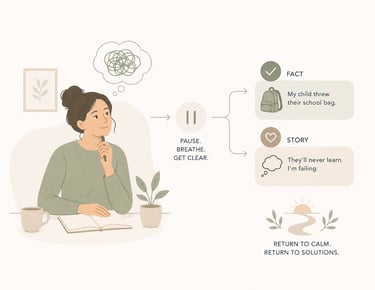
Stress often comes from the stories our minds create rather than the situation itself.
Learning to pause and separate facts from assumptions helps you respond with greater clarity instead of reacting from fear.
Try this: Fact or Story?
When you notice yourself becoming overwhelmed, ask:
What are the facts?
Then ask:
What story am I adding?
Example:
Fact:
"My child threw the school bag."
Story:
"They'll never learn. I'm failing."
Creating this small pause reduces emotional reactivity and helps your brain return to problem-solving.


3. Reconnect with Your Values
Many parents raising neurodivergent children reach a point where they no longer recognise themselves. The appointments, advocacy, daily demands, and constant decision-making slowly consume every part of life until "parent" becomes your only identity.
Your values help you reconnect with the person behind the role and guide your actions when emotions run high.
Try this: The Values Compass
The next time you feel yourself reacting automatically, pause and ask yourself:
What kind of parent—and person—do I want to be in this moment?
Then ask:
What is one small action I can take that reflects those values?
For example:
Situation: Your child refuses to get ready for school.
Your emotions may urge you to shout, argue, or give up.
Your values might guide you towards being calm, patient, consistent, compassionate, or respectful.
The action doesn't have to be perfect. It only needs to move you one small step closer to the person you want to be.
Each small, values-driven choice strengthens psychological flexibility and helps you rebuild trust in yourself as both a parent and a person.
A final thought
Resilience is not built in extraordinary moments.
It is built in ordinary moments, repeated over time.
Every time you pause before reacting, calm your nervous system, or choose your values over your emotions, you strengthen the foundation from which you lead your family.
Connect
Reach out for support and guidance.
© 2026 The Parental Anchor | Elena Arsene, M.Sc. — Psychological Guidance & Parental Well-Being Systems for Parents of Neurodivergent Children.
Disclaimer
Educational Purpose Only: The content, courses, and mentorship provided by The Parental Anchor are for educational and supportive purposes only. This work is focused on parental well-being and resilience; it is not clinical therapy, medical advice, or a substitute for professional mental health diagnosis and treatment.
Professional Boundaries: I do not provide crisis intervention or treatment for severe psychological conditions. If you are experiencing a mental health emergency, please contact your local emergency services or a licensed healthcare provider immediately. By using these resources, you acknowledge that our coaching and digital products are intended for personal growth and preventive well-being.