Building a Life, Not a Fortress:
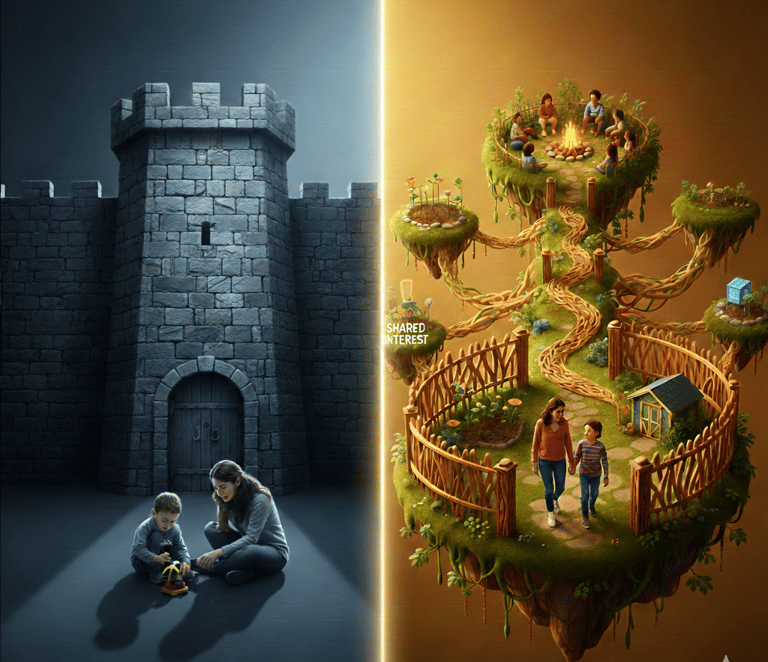
It’s an instinct we all have: When the world feels judgmental, when systems fail us, or when we’re exhausted from explaining our reality, we pull inward. We build walls. We limit exposure. We create a "Fortress" to keep our children safe.
And while protection is an act of love, Isolation is a trap. A fortress keeps the world out, but it eventually runs out of air. True resilience—the kind that lasts a lifetime—requires an ecosystem.
Step 1: The "Safe Space" Pivot
In high-stakes planning, we don't force a fit; we Select the Environment. Inclusion isn't about making your child "tolerate" a loud, overwhelming world. It’s about asking: "Where does our family genuinely belong?"
Building a Life, Not a Fortress: The Strategy of Belonging
Quality over Quantity: Inclusion doesn't mean a crowded party. It might mean one trusted friend, a niche hobby group, or an online community where their neurotype is the norm, not the exception.
Designing for Fit: Stop trying to break into systems that don't want you. Start looking for the "pockets of acceptance" where you and your child can actually breathe.
Step 2: Community as a Biological Resource
Science is clear: For humans, connection is regulation. When you are isolated, your nervous system stays on high alert. You are constantly "scanning for threats."
When you find even one space where you don't have to explain yourself—where you can simply "be"—your chronic vigilance drops. Community isn't an "extra-curricular activity"; it is a biological requirement for your mental health.
Step 3: Your Social World Matters (The Oxygen Mask)
When your life is 100% caregiving, your personal world shrinks until it disappears. This is a strategic error. A parent with a support network makes better decisions and handles stress with more precision.
You need spaces where you are more than just "The Advocate." You need a tribe that sees you. This isn't selfish; it’s a protective factor for your child. A supported parent is a steady parent.
[Image: A "Fortress vs. Ecosystem" comparison. One side shows a dark, walled-in box (Fortress); the other shows a vibrant web of different connections—some large, some tiny—connected by bridges (Ecosystem).]
Step 4: The Sustainability Balance
Designing a life for all ages—childhood through adulthood—means building bridges, not just walls. It means realizing that safety and openness can coexist.
Protection keeps you safe today.
Possibility keeps you going tomorrow.
Sustainability lives in that balance. You aren't just surviving the world; you are building a life within it that has room for joy, connection, and real human ease.
DECIDE NOW: Are you going to keep building walls that isolate you, or are you going to start building the bridges that sustain you?
Connect
Reach out for support and guidance.
© 2026 The Parental Anchor | Elena Arsene, M.Sc. — Psychological Guidance & Parental Well-Being Systems for Parents of Neurodivergent Children.
Disclaimer
Educational Purpose Only: The content, courses, and mentorship provided by The Parental Anchor are for educational and supportive purposes only. This work is focused on parental well-being and resilience; it is not clinical therapy, medical advice, or a substitute for professional mental health diagnosis and treatment.
Professional Boundaries: I do not provide crisis intervention or treatment for severe psychological conditions. If you are experiencing a mental health emergency, please contact your local emergency services or a licensed healthcare provider immediately. By using these resources, you acknowledge that our coaching and digital products are intended for personal growth and preventive well-being.